
Image
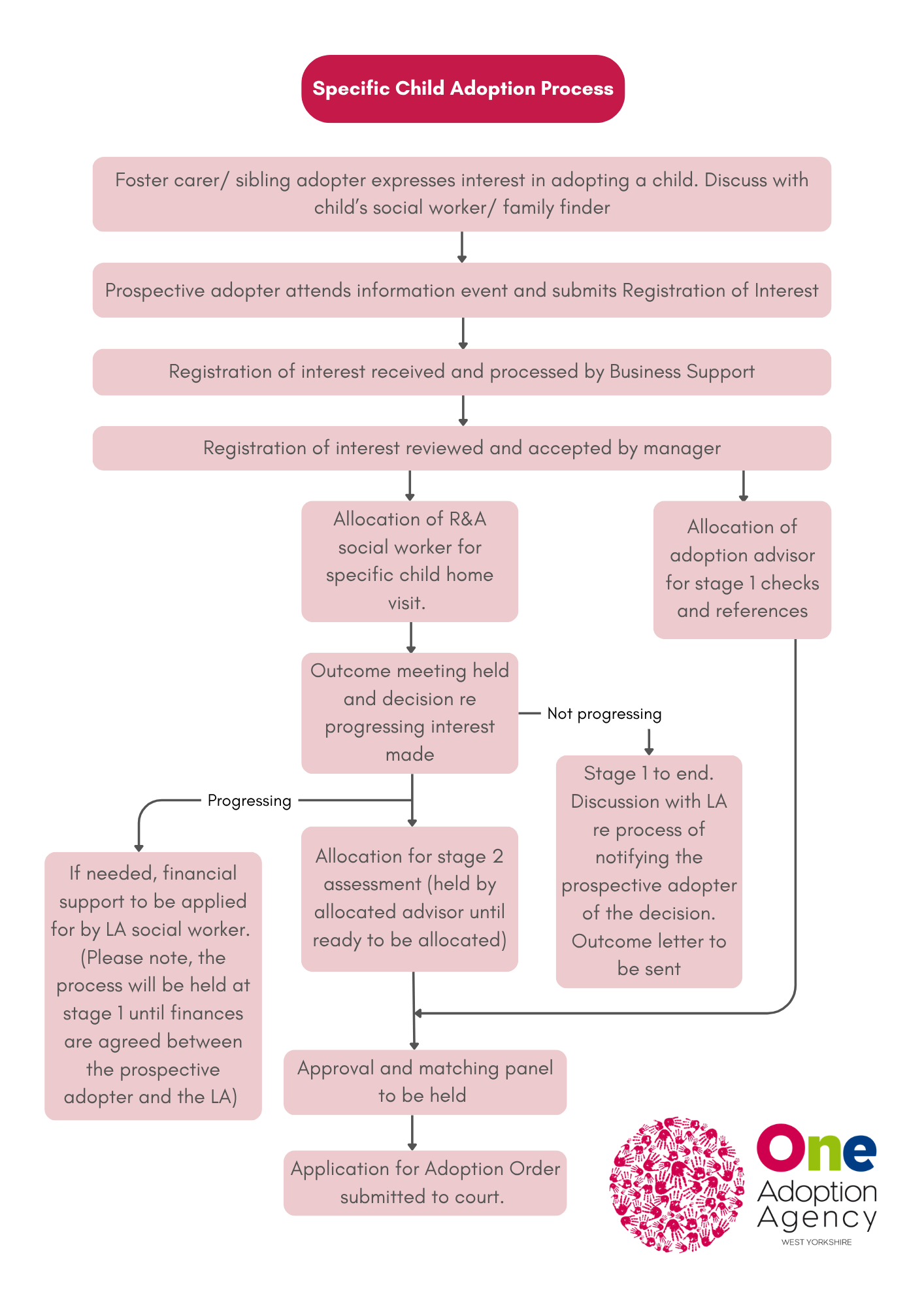
What is a specific child adoption?
- This is an adoption by someone already known to the child/ren or with a pre-existing relationship to the child/ren, such as foster carers, family friends, or adopters of older siblings
- It is different from the early linking process, which focuses on families in the initial stages of the adoption process.
If you have any questions about the process, please contact the family finding manager for your local authority, or the R&A Team 1 managers in OAWY.
This guide takes you through the various stages and steps in the process.
Step 1: Early indication of interest in adopting
- Expressions of interest can come from various sources and can be pre-SHOBPA if the IRO agrees.
- A family finder will be allocated by the family finding team manager for the relevant local authority if not already.
Step 2: Informal discussion
- Informal discussions take place with the family finder, potential prospective adopter, and relevant social workers.
- Topics include finances, life stage, children in the household, other commitments (e.g. outside caring responsibilities, work), and the child's needs.
- Applicants are advised to attend an information event which can be booked here
Step 3: Submitting a Registration of Interest (ROI) and specific child home visit
- Prospective adopters who wish to be considered should submit a Registration of Interest (ROI) form following attendance at the information event. This will be processed by business support.
- The ROI will be accepted by an adoption team manager and an adoption social worker allocated to undertake an initial home visit alongside the child’s social worker. The family finder does not need to attend this visit but will be part of the discussions.
- An adoption advisor will also be allocated to undertake stage 1 checks and references alongside the visit taking place.
- The initial home visit should to be scheduled to take place within two weeks and include the child's social worker. The child’s social worker must attend for the visit to proceed;
- this is so that they can hear relevant information about the prospective carers and ensure that they have shared relevant information about the child/children.
- The decision/outcome meeting should be arranged at the same time as booking the visit to allow everyone to prioritise this meeting and prevent delay. The child’s social worker and team manager will need to attend this meeting or it will not proceed.
- The specific child home visit is led and recorded by the R&A social worker, with the child's social worker present to answer any questions, provide information about the child’s background/history and ensure they have heard information about the prospective adopters.
- The discussion includes key areas such as finances, support network, the child's needs, the needs of other children in the household, the life stage and age of the carers, and ongoing plans for fostering (if relevant), as well as discussing topics relevant to all adopters, such as their family make up, relationship status, journey to adoption, childcare experience and statutory checks.
- The visit is formally recorded by OAWY but a copy of the visit write up will be shared with the local authority.
Stage 4: Professionals' meeting/decision making
- This meeting should take place within one week of the home visit to agree on an outcome and progress the child's care plan.
- The meeting is attended by relevant social workers and team managers. The child’s team manager must attend for the meeting to progress. The adoption advisor, the child’s family finder and the supervising social worker for foster carer adopters are also invited. The meeting will be chaired by a R&A manager from OAWY and will be minuted by OAWY; minutes of the meeting will be shared with the local authority.
- The IRO's views can be voiced via the child’s social worker but IROs do not attend the meeting.
Stage 5: Proceeding to specific child adoption
- Following the outcome meeting an outcome letter will be sent to the family by OAWY (with a copy to local authority), and ongoing adoption financial support will be considered and arranged by the child’s local authority if appropriate
- The child’s social worker and family finder play a key role in progressing finances and will need to liaise regarding this. Once financial support has been agreed and a signed agreement exists between the prospective adopters and the local authority, a copy of the signed agreement should be sent to the relevant R&A Team 1 manager and it should be added to mosaic by the family finder.
- Stage 1 checks, references and preparation group will be undertaken once the ROI has been accepted; any financial support that is required will be agreed during stage 1.
- Following the outcome meeting, if no financial support is required, the prospective adopters will be added to the allocations list for the next allocations meeting (held once per month) for stage 2 assessment with a social worker.
- If financial support is required, the prospective adopters will remain in stage 1 until this is agreed. If stage 1 is completed prior to finances being agreed, the prospective adopters will be placed on hold at the end of stage 1. Once finances are agreed, the prospective adopters will be added to the list for stage 2 allocations.
- Once allocated for stage 2 assessment, this will run alongside any outstanding stage 1 checks/references/preparation training and the normal assessment and matching process will apply.
- Specific child adopters are adopters like any other and therefore they will have the opportunity of a linking meeting with the child’s social worker ahead of matching panel and will meet with the medical advisor, have a copy of the child’s updated CPR and any other documents and attend any other meetings relevant to the matching process, such as a life appreciation day if appropriate. Sufficient time needs to be scheduled in for this process to take place. It may also be helpful to meet with the Multi Disciplinary Team to think about adoption support planning and we would anticipate the local authority being active players in this process.
- Relevant adoption support will be progressed following the child/ren being formally placed for adoption, e.g. access to the agency’s core offer or any work funded by the Adoption and Special Guardianship Support Fund.
Not proceeding to specific child adoption
- In some cases, the local authority may take the decision not to proceed with a specific child adoption; this may be because of concerns regarding the ability of the applicants to meet the child or children’s needs, or if there is more than one interested party to consider.
- In cases where the local authority have decided not to proceed with a specific set of prospective adopters, the decision should be communicated to the family in person, with advice and information on next steps. It is expected that any meetings with the family will be jointly attended by OAWY and the relevant Local Authority; this is because the local authority holds care planning responsibility for the relevant child or children and should communicate their decision in person. OAWY will support this process and offer adoption specific information and advice, including the opportunity to remain in the adoption process as general prospective adopters if appropriate.
- A formal outcome and decision letter should be prepared and sent out; this is a joint letter from OAWY and the relevant Local Authority and should be written jointly; the specifics of how to do this need to be discussed between the relevant managers. The letter should be recorded on both the OAWY mosaic file and the local authority file.
Download our bite sized guide to specific child adoption here
Document
specific_child_adoption_bite_size_.pdf
(231.2 KB)
Download the adoption process diagram here
Document
specific_child_adoption_process.pdf
(155.58 KB)
Download our bite sized guide to adopting the child you foster here
Document
adopting_the_child_you_foster.pdf
(2.21 MB)